
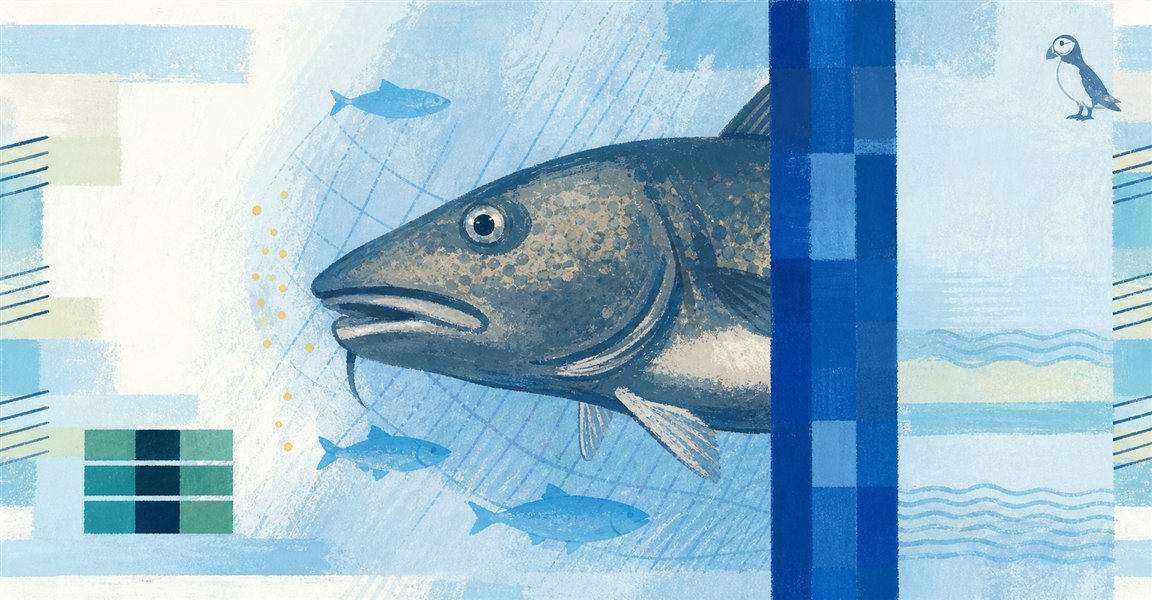
Norwegian banknotes do something unusual: they tell one continuous story. The front of each note looks back at a recognisable maritime object, while the reverse turns sea and wind into a modern field of pixels. Move from 50 to 1,000 kroner and the weather grows rougher, as if the wallet itself were sailing away from a sheltered harbour.
The current Series VIII has 50, 100, 200, 500 and 1,000 kroner banknotes. The circulation coins are 1, 5, 10 and 20 kroner; there are no current øre coins. The silver-coloured 1- and 5-krone coins have centre holes, while the 10 and 20 are warm gold-coloured pieces.
Paper money
Norwegian krone notes turn coast, sea and weather into a vivid colour journey, from the purple 50 to the turquoise 1,000.
Norway's banknotes follow the sea: a lighthouse, Viking ship, cod, rescue vessel and open wave connect coastal history with a pixel-like wind pattern on the reverse. Cash by Country artwork is an original, simplified interpretation and is not legal tender.
The whole banknote series sails in one direction
Each value gives the sea a different job
Norges Bank divided the series into five chapters: the sea that binds Norway together, takes it into the world, feeds it, gives it prosperity and carries it forward. That progression explains why a lighthouse belongs on the smallest note, a cod sits in the practical middle and a full wave finishes the series.
The reverse side is a weather report in pixels
The cubic patterns on the backs follow the Beaufort scale. Calm, short blocks on the lower values stretch into longer, more turbulent forms as the denomination rises. Organic lines suggest water beneath them. It is not decoration pasted onto five notes; it is one visual system that makes the wind stronger from wallet left to wallet right.
A puffin hides in every denomination
Hold a genuine note to the light and the watermark reveals an Atlantic puffin head beside the value. Tilt the note to find a floating ring and, on all denominations except the 50, an anchor chain that seems to move through the paper. Use several features together rather than trusting colour or one familiar picture.
Two holes organise the coin pocket
The 1- and 5-krone coins were deliberately designed with centre holes, helping distinguish them by touch and preventing confusion with the larger-value coins. The 1-krone reverse borrows a bird from the carved portal of Hylestad Stave Church. The two brass-coloured coins keep 10 and 20 kroner visually separate from the silver pair.
The 100 and 200 are the traveller's working notes
Cards handle most Norwegian spending, so a large cash stack is unnecessary. A few 100- and 200-kroner notes are easier to use at a staffed shop, small event or countryside stop than a 1,000-kroner note. Keep the 10- and 20-kroner coins for the rare machine, locker or simple cash moment.