

Cash is Japan's physical money, a bank card handles larger purchases, and an IC card lives between them. It stores yen for quick taps, removes the need to calculate local train fares in advance and turns small everyday payments into something almost invisible.
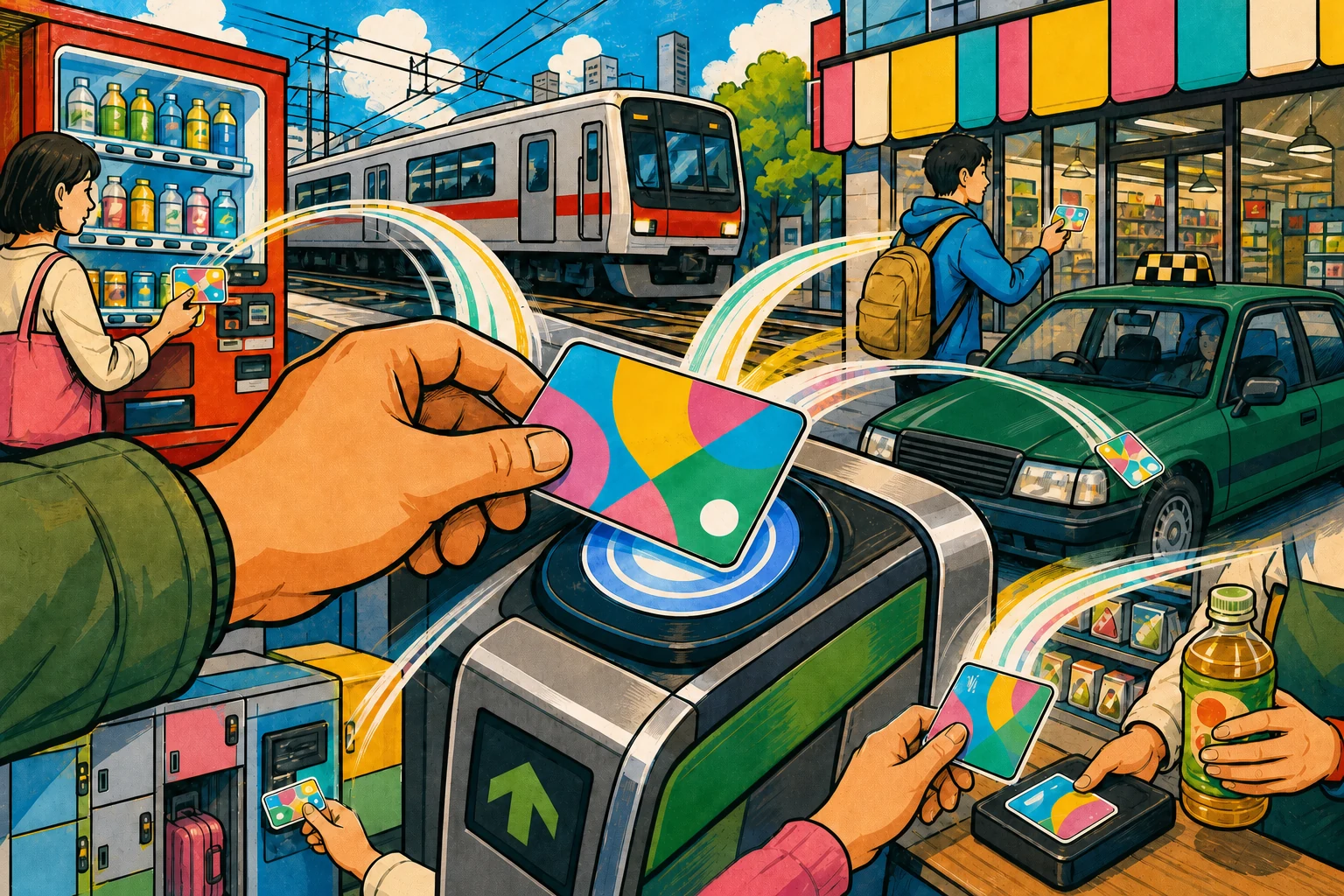
Why an IC card feels like hidden coins
An IC card is prepaid electronic money. Add yen to the balance, touch a reader, and the fare or purchase is deducted. There is no signature, PIN or hunt for the right coins. At a station gate, the system also calculates the local fare when you tap out.
This is why the card quickly stops feeling like a ticket. The balance becomes a pocket of digital change, ready for the moments when taking out a credit card feels slow and feeding coins into a machine feels unnecessary.
Where can you use it?
The safe rule is simple: look for the nationwide transportation IC mark or the name of a compatible card at the reader. Acceptance can vary by location, even within the same chain.
The 7-Eleven test
7-Eleven Japan officially accepts Kitaca, Suica, PASMO, TOICA, manaca, ICOCA, SUGOCA, nimoca and Hayakaken. At a self-service register, select Transportation IC Card, then hold the card or phone over the reader. That small purchase is a good first test before relying on the card at a busy station gate.
Suica, PASMO, ICOCA: which name should you choose?
Japan's cards have regional names, but the major cards share a nationwide mutual-use network. For a normal visitor, the easiest answer is usually to buy the card sold where the trip begins. A Suica bought in Tokyo can still work in participating ICOCA territory around Osaka and Kyoto, and an ICOCA can work on much of Tokyo's network.
| Card family | Home region | Traveler cue |
|---|---|---|
| Suica / PASMO | Tokyo and eastern Japan | Most familiar choices after arriving in Tokyo |
| ICOCA / PiTaPa | Osaka, Kyoto and western Japan | ICOCA is the straightforward prepaid visitor choice |
| TOICA / manaca | Nagoya and central Japan | Useful when central Japan is the starting point |
| Kitaca | Hokkaido | Regional card with broad mutual-use support |
| SUGOCA / nimoca / Hayakaken | Kyushu and Fukuoka | Buy locally and use on participating national networks |
Names are shown as plain editorial references, not as reproduced logos. PiTaPa has an important exception: its electronic-money function is not part of nationwide mutual use.
The best visitor choices in 2026
Welcome Suica
JR East's tourist card lasts 28 days from purchase. There is no ¥500 deposit, but unused stored value is not refundable.
TOURIST PASMO
Launched for overseas visitors in May 2026. It also lasts 28 days, carries no refundable balance and can be topped up during the trip.
Mobile IC
Supported iPhones and Apple Watches can hold Suica, PASMO, ICOCA or TOICA. JR East also offers Welcome Suica Mobile for iOS visitors.
Regular Suica and PASMO cards are another option and their non-personalized sales resumed in March 2025. They normally require a ¥500 deposit and follow the issuing operator's refund rules. This can make a regular card more suitable than a 28-day tourist card for a longer stay.
Mobile setup is wonderfully convenient when it works, but device, region and payment-card compatibility can change. Test issuance and top-up before treating the phone as your only plan. As of July 2026, the dedicated Welcome Suica Mobile tourist app is available for iOS; JR East has announced Samsung Galaxy support for the first half of 2027.
How much should you load?
Start smaller than you think. Around ¥2,000 to ¥3,000 is enough to learn your daily rhythm without trapping a large balance on a non-refundable tourist card. Add more when needed. Physical Welcome Suica and TOURIST PASMO balances can be topped up to ¥20,000.
At station machines, choose the English-language option, place or insert the card as shown, select the amount and feed in yen. Some convenience stores can also recharge supported cards. The remaining balance is normally shown at ticket gates, vending machines and compatible checkout displays.
Four traps worth knowing
Nationwide does not mean every journey
A major card works inside many separate IC regions, but you generally cannot make one continuous stored-value rail journey across disconnected IC card areas. Buy a ticket before entering when crossing an area boundary.
Shinkansen needs another layer
Do not assume the balance itself buys a bullet-train ride. With SmartEX, the card must be registered to a reservation; the Shinkansen fare is charged through the reservation service, not deducted from the IC balance.
Limited express can need an extra ticket
The IC balance may cover the basic local fare while a limited-express, reserved-seat or Green Car supplement must be purchased separately.
Several cards can confuse the reader
Take the intended card out of a wallet containing other contactless cards. Enter and exit with the same physical card, phone or watch.
What happens if the card is lost?
Treat an anonymous physical IC card like cash. An unregistered PASMO cannot be reissued if lost, and the balance on a tourist card is not refundable simply because the card disappears. Personalized regular cards can offer reissue procedures, but registration takes more time and the rules depend on the issuer.
A mobile card may have account-based recovery options, but a flat battery or damaged phone can still be inconvenient at a gate. Keep enough cash for the next ride and do not make one device your only source of money.
Spend the final balance before leaving
Short-term Welcome Suica and TOURIST PASMO balances are not refunded. During the final day, use the card for local transport, an airport vending machine or a convenience-store purchase. Some readers do not allow a split payment between IC balance and cash, so spending the last few yen can require a little planning.
Quick answers
Can one card cover Tokyo, Kyoto and Osaka?
Usually for local travel inside each participating area, yes. It does not mean you can tap into Tokyo and stay inside the gates all the way to Kyoto, and it does not include every rural railway or bus.
Do I need both Suica and PASMO?
No. Their everyday transport and shopping coverage overlaps heavily through mutual use. Choose the one that is easiest to obtain.
Can I use it in a taxi?
Some taxis accept transportation IC cards. Look for a compatible mark or ask the driver before the meter starts. Keep cash or a bank card available for taxis without the reader.